
Why a Properly Tuned Chip Breaker Makes All the Difference
In the world of hand tools, few components are as underestimated as the chip breaker (also known as the cap iron). While the frog, blade quality, and sole flatness often receive the most attention, the chip breaker quietly determines whether a plane behaves like a refined cutting instrument or a frustrating block of cast iron. A properly tuned chip breaker can elevate even a modest plane into a high-performing tool, delivering smoother surfaces, reduced tear-out, and greater overall control.

The primary role of the chip breaker is to influence how shavings curl and fracture as they leave the cutting edge. By interrupting and redirecting the shaving before it has a chance to lift and split the fibres ahead of the blade, the chip breaker dramatically reduces tear-out especially in reversing grain and difficult timbers. But this only works if the breaker is tuned with precision. A gap, poorly polished underside, or incorrect angle will compromise performance and leave the plane prone to chatter, clogging, or inconsistent cutting behaviour.
A properly fitted chip breaker starts with contact. The leading edge must meet the back of the blade with a light-tight seal. Even the smallest opening at this interface creates a pocket where shavings catch, building up until the plane stutters or jams. By carefully flattening and polishing the underside of the breaker’s leading edge, and ensuring it mates tightly to the iron, you eliminate these problems and create a shaving path that stays consistent and reliable.
A properly fitted chip breaker starts with contact. The leading edge must meet the back of the blade with a light-tight seal. Even the smallest opening at this interface creates a pocket where shavings catch, building up until the plane stutters or jams. By carefully flattening and polishing the underside of the breaker’s leading edge, and ensuring it mates tightly to the iron, you eliminate these problems and create a shaving path that stays consistent and reliable.
Positioning is equally crucial. The distance between the breaker and the cutting edge dictates how the shaving is controlled. When set extremely close often within 0.1 to 0.3 mm the chip breaker forces the shaving to curl quickly and sharply, preventing fibres from lifting ahead of the cut. This is what allows a standard bevel-down bench plane to rival the performance of much steeper modern bevel-up designs or high-angle frogs. A well-tuned cap iron, used correctly, is one of the most elegant and efficient solutions to tear-out ever invented.
However, tuning does not end at the edge. Stock chip breakers often come with burrs, rough machining marks, or coatings that disrupt shaving flow. Polishing the top surface behind the leading edge reduces friction and helps shavings glide over the breaker rather than snag on imperfections. This subtle improvement significantly enhances the plane’s feel, making it smoother, quieter, and more predictable in use.
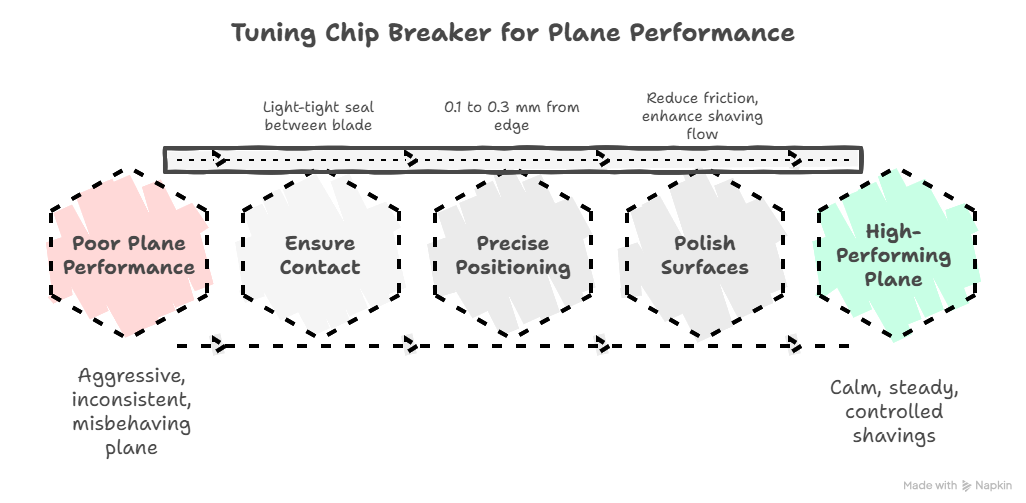
The keys to a properly functioning chip breaker
The cumulative result of this tuning is transformative. A plane with a well sharpened blade but poorly fitted chip breaker may feel aggressive, inconsistent, and prone to misbehaving on dense or interlocked grain. In contrast, the same plane equipped with a carefully tuned chip breaker becomes a different tool entirely: calm, steady, and capable of taking gossamer-thin shavings on timbers that would otherwise tear out disastrously.
For woodworkers seeking to push the performance of their hand planes, mastering the chip breaker is non-negotiable. It is one of the few adjustments that costs nothing except time yet offers gains on par with premium replacement blades and expensive upgrades. A properly tuned chip breaker does not merely improve a plane it unlocks its full potential, making every pass at the bench more efficient, more controlled, and unmistakably satisfying.
